
Use Case
Building clinician and patient usability into early nonclinical strategy
-
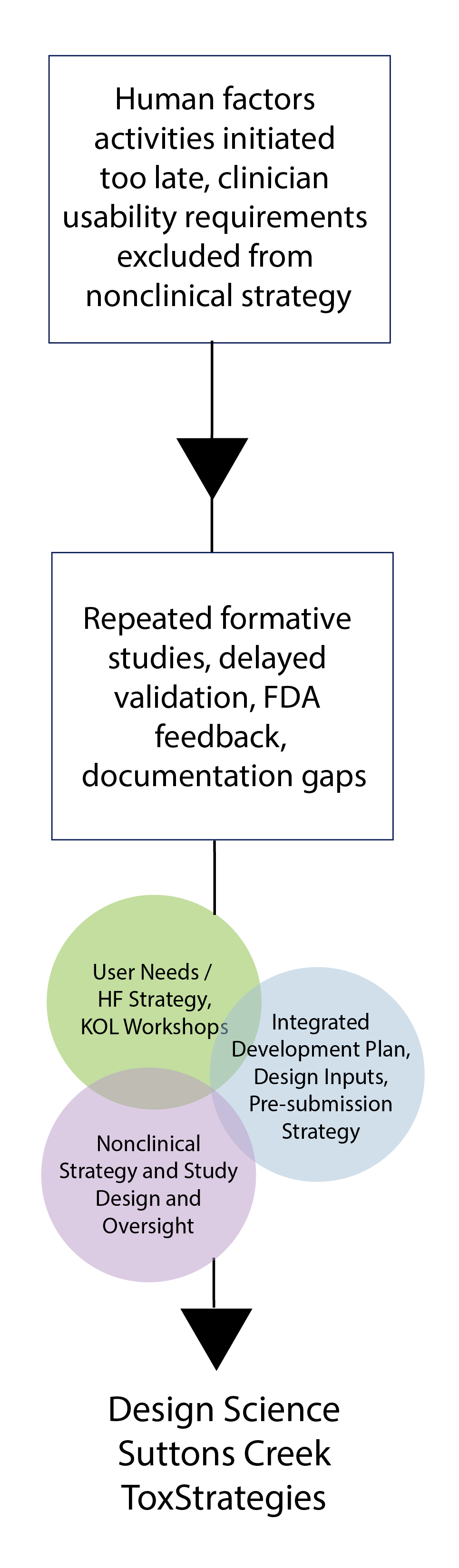
A sponsor finalizing early nonclinical strategy hasn't yet incorporated clinician usability or human factors requirements — those considerations are treated as a downstream device/HF workstream rather than part of the nonclinical program itself.
-
Human factors activities initiated too late relative to nonclinical planning
Repeated formative studies
Delayed validation
FDA feedback requiring rework
Documentation gaps between nonclinical and HF programs
-
Design Science — User needs and HF strategy defined early, contextual inquiry and KOL workshops feeding into nonclinical planning
Suttons Creek — Integrated development plan sequencing HF and nonclinical milestones, design inputs linking user needs to nonclinical endpoints, pre-submission strategy to confirm FDA expectations early
ToxStrategies — Full nonclinical strategy design incorporating drug and device considerations, nonclinical study design, oversight aligned to anticipated HF/usability needs, design and support to in vivo nonclinical translational procedural models, clinician evaluations
-
Human factors and clinician usability requirements are embedded in nonclinical strategy from the outset, avoiding repeated formative studies and late-stage FDA feedback.