
Use Case
Transitioning a biologic program from vial to autoinjector
-
A sponsor advancing toward Phase 3 determines that a self-administration strategy will be necessary for long-term commercial competitiveness and patient adoption.
-
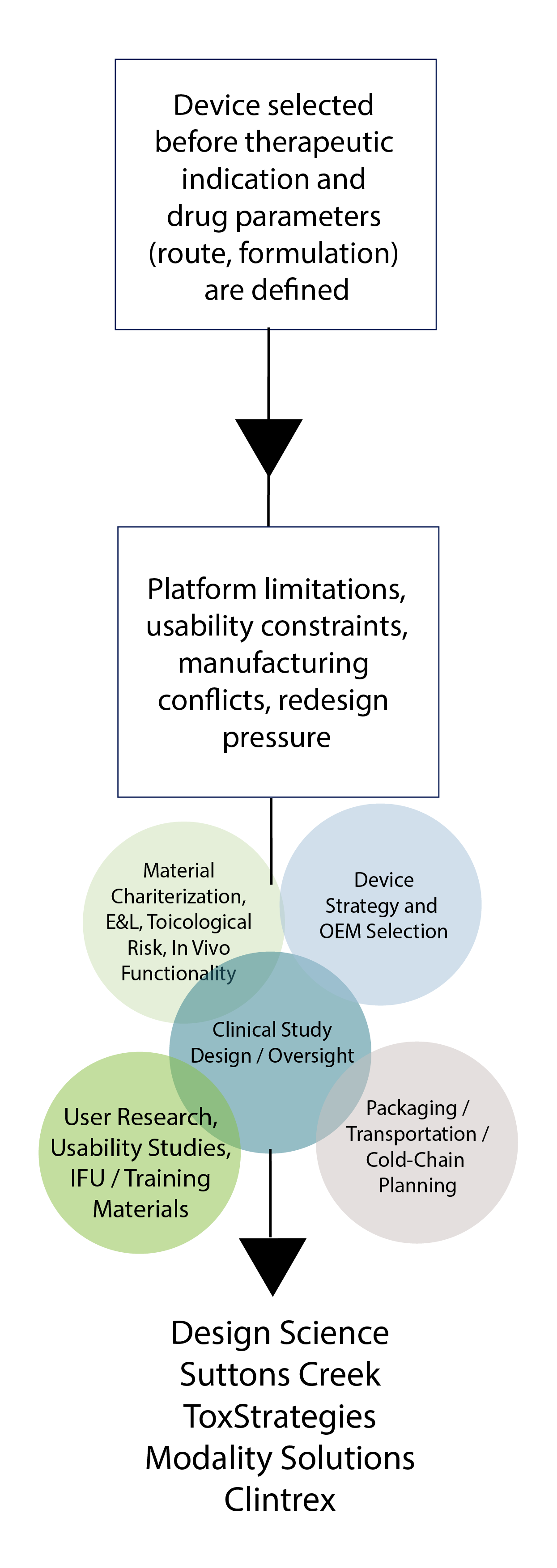
Selecting an appropriate delivery platform before therapeutic indication and drug parameters (route, formulation) are fully defined
Understanding patient usability risks; aligning formulation and device constraints
Managing OEM interactions
Preparing for future HF validation
-
Design Science — User research and contextual inquiry, URRA, formative usability studies, IFU and training material development
Suttons Creek — Device strategy and platform evaluation, OEM selection and management, essential performance requirements, design controls established ahead of Phase 3 device lock
ToxStrategies — Material characterization strategy, E&L planning, toxicological risk assessment support, in vivo functionality assessments
Modality Solutions — Packaging and transportation considerations, cold-chain and shipping simulation planning, product robustness assessment for dose delivery and container closure integrity
Clintrex — Clinical study design and oversight for self-administration and human factors validation studies, bridging device-transition data to Phase 3 readiness
-
An integrated development pathway aligned to anticipated submission, usability, manufacturing, and commercialization requirements before late-stage validation activities begin.